
Do porta potties freeze in winter?
Short answer
Yes, an untreated porta potty tank can freeze, because the charge in it is mostly water. Operators prevent it by mixing a freeze-point depressant into the charge: rock salt brine, magnesium chloride or methanol. Half a pound of salt per gallon protects to about 26°F, and 2 pounds of magnesium chloride per gallon to -20°F. Expect a winter fee of $10 to $20 per unit per billing cycle.
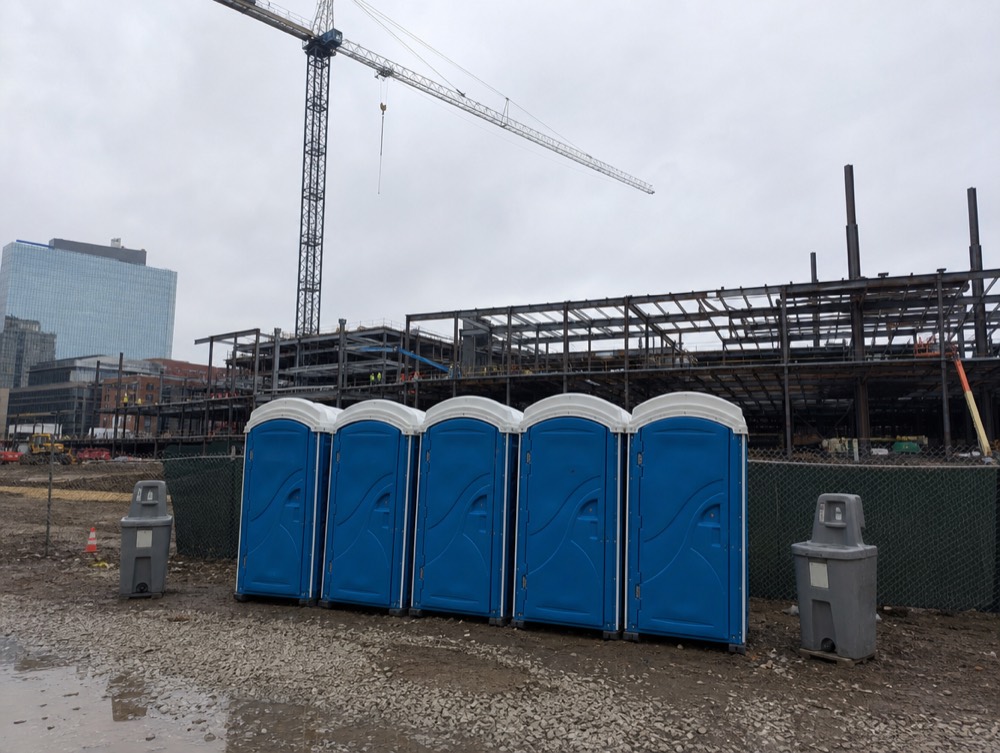
Winter does not stop a jobsite, and it does not have to stop the porta potty. Three things change: what goes into the tank, what happens to the hand wash station, and how the truck gets to the unit. Here is how each one works, with the numbers.
What freezes, and when
A clean unit starts with a charge of 5 to 10 gallons of water with biocide and fragrance, and the tank fills from there (PSAI Guide, p. 6). Untreated, that liquid behaves like water and starts to freeze at 32°F. A frozen tank cannot be pumped on service day, so the unit fills up and stays out of use until it thaws.
Three parts are at risk:
- The holding tank, which is why operators treat the charge.
- The hand wash station, whose fresh-water tank, pump and faucet freeze like any water line.
- The route to the unit. Snow and ice do not freeze the unit, but they stop the truck, and a skipped service does the same damage.
How operators winterize the tank
The fix is a freeze-point depressant mixed into the charge. A portable restroom manufacturer's winterization guide lists the common options and the protection each one gives (listed under Sources):
| Additive | Mix per gallon | Protects down to |
|---|---|---|
| Methanol | 6.5 oz | 28°F |
| Rock salt brine | 1/2 lb | 26°F |
| Magnesium chloride | 1/2 lb | 26°F |
| Rock salt brine | 2 1/4 lb (saturated) | 0°F |
| Methanol | About 42 oz (33%) | -9°F |
| Magnesium chloride | 2 lb | -20°F |
| Rock salt plus methanol | 2 lb salt + 40 oz methanol | -40°F |
Rock salt stops at 0°F however much is added, which is why colder regions use magnesium chloride or methanol. Each has a cost for the operator: brine corrodes steel tanks on the service truck, and methanol becomes flammable above a 33 percent mix. That is why the choice and the dose belong to the operator, who knows the tank, the forecast and the service interval. Do not add anything to a unit yourself.
Hand wash stations in freezing weather
A freestanding hand wash station carries fresh water, and fresh water cannot be treated with antifreeze, because people wash their hands in it. Below freezing, the tank, the pump and the faucet can freeze. Ask dispatch how the operator handles stations on your site in freezing weather, and ask before the first cold snap, not after.
Do not replace the station with a sanitizer dispenser where the rules require washing. Where crews work with paints, coatings or other harmful contaminants, OSHA expects soap and water near the work, and has said waterless cleaner typically is not enough (OSHA letter, 2005). The details are in the hand washing requirements guide.
Keep the route open for the truck
Most winter service problems are access problems. A truck that cannot reach the unit skips it, and a week of use goes into a tank that was due to be pumped.
- Clear the route from the road to the units, including the last few feet to the door.
- Do not let plowed snow get piled against the units or across the path.
- Place units out of drifting snow where you can, for example on the sheltered side of a building or a site trailer.
- Give dispatch gate codes and tell them when the site plows, so service day and snow removal line up.
What a winter rental costs
| Winter antifreeze | $10-$20 per unit per billing cycle (both guides) |
|---|---|
| Extra service visit | $30-$60 (national guide); $75-$150 per trip in CT, NY, NJ |
| Peak season | April to October; prices are higher then (national guide) |
Sources: 2026 price guides published by US rental operators, listed below. These are published ranges, not our price. The winter fee is small next to the rental itself; what matters is that it is on the quote, with the month it starts. Full pricing is in how much it costs to rent a porta potty.
When to call
Call before the first hard freeze. A unit that has already frozen has to thaw before it can be serviced. Tell dispatch:
- the address and how the truck gets in, including gates and plowing;
- crew size and shifts, since the count does not change in winter (how many porta potties you need);
- whether you need a hand wash station;
- the months you expect freezing temperatures on site.
Common questions
At what temperature does a porta potty freeze?
Untreated, around 32°F, like water. With half a pound of rock salt per gallon the charge is protected to about 26°F, and to 0°F at saturation. Magnesium chloride and methanol blends protect to lower temperatures.
Can you rent a porta potty in winter?
Yes. Operators winterize the tank with salt brine, magnesium chloride or methanol and bill a small winter fee.
How much does it cost to winterize a porta potty?
Published 2026 price guides list $10 to $20 per unit per billing cycle for antifreeze. The local operator sets the final price.
Do hand wash stations work in winter?
Their fresh-water tank can freeze and cannot be treated with antifreeze. Ask dispatch how the operator handles stations on your site before the first freeze.
Can I put a heater inside a porta potty?
Do not put a fuel-burning heater inside. A unit is a small enclosed space, and combustion heaters give off carbon monoxide. Ask the operator what they offer for cold sites.
Sources
- PSAI, Guide to Portable Restroom Excellence (2023)\2
- Winterization guide published by a portable restroom manufacturer
- 2026 price guide published by a national rental marketplace (April 23, 2026)
- 2026 price guide published by a rental operator in Connecticut, New York and New Jersey (September 4, 2026)
- OSHA interpretation, July 20, 2005: washing facilities on construction jobsites\2
General information, not legal advice. Porta Potty US connects callers with licensed, insured local operators; prices are quoted by the operator who delivers.
Keep reading
-
 Service
How often are porta potties cleaned?
The standard is once a week.
-
 Construction
Porta potty rental for construction sites
A construction site needs toilets from the first worker on site.
-
 Compliance
OSHA hand washing requirements for construction sites
OSHA requires washing facilities near the work, with soap and water, whenever a construction crew handles paints, coatings, herbicides, insecticides or other harmful contaminants.
Porta potty rental near you