
OSHA porta potty requirements for construction sites
Short answer
OSHA 29 CFR 1926.51(c) requires toilets on construction jobsites: one facility for 20 or fewer workers, one toilet seat and one urinal per 40 workers above that, and one of each per 50 workers at 200 or more. Sites without a sewer must use chemical, recirculating or combustion toilets, or privies where local code allows.
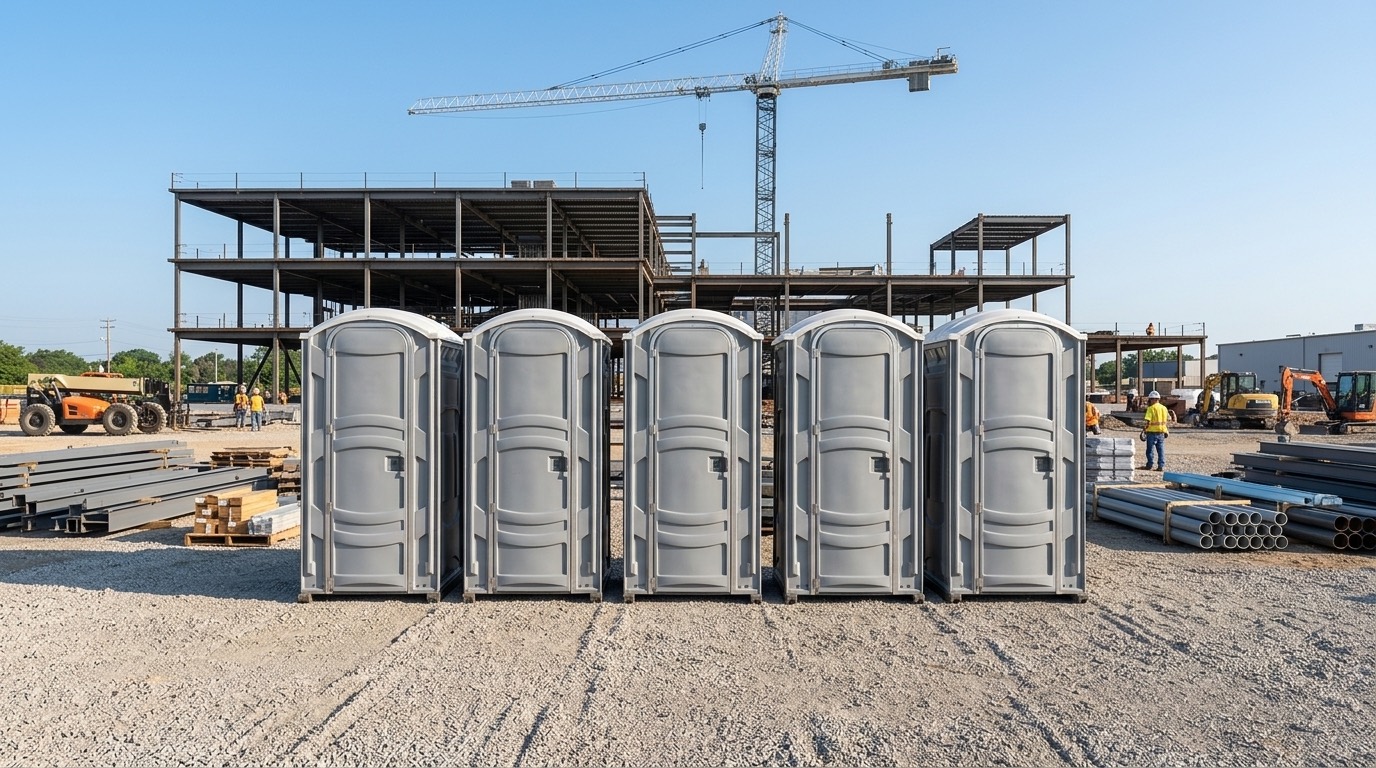
This is the federal rule, quoted from the regulation itself, with worked examples. It covers what an inspector checks. It is not legal advice, and a State Plan or your contract can require more.
The rule: Table D-1
Section 1926.51(c)(1) says toilets "shall be provided for employees according to the following table" (OSHA, 29 CFR 1926.51, Sanitation (construction)):
| Number of employees | Minimum number of facilities |
|---|---|
| 20 or less | 1 |
| 20 or more | 1 toilet seat and 1 urinal per 40 workers |
| 200 or more | 1 toilet seat and 1 urinal per 50 workers |
Read literally, the table counts toilet seats and urinals, not units. Most standard portable toilets have both a seat and a urinal inside, which is why crews usually count one unit per line. If your project has a safety officer, confirm how they count before the first delivery.
Worked examples
| Workers | OSHA minimum | Z4.3, one shift |
|---|---|---|
| 10 | 1 facility | 1 unit |
| 20 | 1 facility | 2 units |
| 35 | 1 seat + 1 urinal | 4 units |
| 60 | 2 seats + 2 urinals | 6 units |
| 120 | 3 seats + 3 urinals | 12 units |
| 250 | 5 seats + 5 urinals | 25 units |
The OSHA column is the legal floor. The right-hand column is the industry standard from ANSI/PSAI Z4.3, which sizes one unit for no more than 10 workers on a 40-hour week with weekly service (PSAI Guide, p. 9). The two answer different questions: OSHA asks whether a toilet exists, Z4.3 asks whether it is still usable on Thursday. Most jobsites order closer to the Z4.3 number. The porta potty calculator shows both side by side.
What kind of toilet counts
A jobsite with a sanitary sewer can use flush toilets. A site without one must provide one of these, "unless prohibited by local codes" (1926.51(c)(3)):
- privies, where their use will not contaminate ground or surface water;
- chemical toilets, which is what a standard porta potty is;
- recirculating toilets;
- combustion toilets.
Under temporary field conditions the rule is simpler: provisions must be made so that at least one toilet facility is available (1926.51(c)(2)).
The mobile crew exception
The toilet requirement does not apply to "mobile crews having transportation readily available to nearby toilet facilities" (1926.51(c)(4)). A utility crew moving between stops with a truck qualifies. A crew parked on one site for the week, with the nearest restroom a drive away, is a judgment call you should not make on your own. For crews that move every few days, a porta potty mounted on a towable trailer settles the question.
Hand washing is a separate requirement
Section 1926.51(f) is easy to miss because it is not in the toilet paragraph. For work with paints, coatings, herbicides, insecticides or other harmful contaminants, the employer must provide washing facilities in "near proximity to the worksite", equipped so employees can remove those substances (1926.51(f)(1)). OSHA has said that waterless hand cleaner and rags typically do not meet that bar (OSHA letter, 2005).
The lavatory paragraph, 1926.51(f)(3), reads "all places of employment", but OSHA has interpreted it as applying to permanent places of employment, not to every temporary jobsite (OSHA memo, 1994). State Plans can go further: California requires one washing station per 20 workers on construction sites. The full picture is in our hand washing requirements guide.
What 1926.51 does not say
It sets no distance in feet. Figures like "within 200 feet" circulate online, but they are not in the construction standard. If a State Plan, a project specification or a general contractor's safety plan sets a distance, that document governs.
It does not set a cleaning schedule. OSHA requires sanitary facilities; the weekly service interval comes from the industry standard, not the regulation. See how often porta potties are cleaned.
Farms follow a different, stricter rule
Agriculture is not covered by 1926.51. The field sanitation standard, 29 CFR 1928.110, applies when 11 or more employees do hand labor in the field on any given day (OSHA, 29 CFR 1928.110, Field sanitation (agriculture)). It requires:
- one toilet and one hand washing facility for each 20 employees or fraction of 20;
- both located within a one-quarter-mile walk of each worker's place of work, or at the closest vehicle access point where terrain makes that impossible;
- toilets that are ventilated, screened, lockable from the inside and private.
Facilities are not required for employees who do three hours or less of field work in a day, including travel time to and from the field.
State Plans can be stricter
A number of states run their own OSHA-approved State Plans. They must be at least as effective as federal OSHA and can set stricter rules (OSHA, State Plans). California is the best-known example. If your site is in a State Plan state, check the state's sanitation rule before you rely on Table D-1 alone.
Common questions
Does OSHA require porta potties on construction sites?
Yes. 29 CFR 1926.51(c) requires toilets on construction jobsites, and sites without a sanitary sewer must use chemical toilets, recirculating or combustion toilets, or privies where local code allows.
How many porta potties does OSHA require per worker?
One facility for 20 or fewer workers, one toilet seat and one urinal per 40 workers above 20, and one of each per 50 workers at 200 or more.
Does OSHA say how far the toilet can be from the work area?
The construction standard, 1926.51, sets no distance in feet. The farm standard, 1928.110, sets a one-quarter-mile walk.
Does OSHA require hand washing stations on jobsites?
When crews work with paints, coatings or other harmful contaminants, yes: 1926.51(f)(1) requires washing facilities near the worksite. The general lavatory rule applies to permanent places of employment, per OSHA's 1994 interpretation. California requires one station per 20 workers.
Are mobile crews exempt?
Yes, if they have transportation readily available to nearby toilet facilities, under 1926.51(c)(4).
Sources
- OSHA, 29 CFR 1926.51, Sanitation (construction)\2
- OSHA, 29 CFR 1928.110, Field sanitation (agriculture)\2
- OSHA, State Plans\2
- PSAI, Guide to Portable Restroom Excellence (2023)\2
- OSHA interpretation, February 10, 1994: 1926.51(f)(2)-(f)(4) apply to permanent places of employment\2
- OSHA interpretation, July 20, 2005: washing facilities on construction jobsites\2
General information, not legal advice. Porta Potty US connects callers with licensed, insured local operators; prices are quoted by the operator who delivers.
Keep reading
-
 Planning
How many porta potties do I need?
For a jobsite, plan one standard unit per 10 workers on a 40-hour week, serviced weekly: that is the ANSI/PSAI Z4.3 standard.
-
 Construction
Porta potty rental for construction sites
A construction site needs toilets from the first worker on site.
-
 Compliance
OSHA hand washing requirements for construction sites
OSHA requires washing facilities near the work, with soap and water, whenever a construction crew handles paints, coatings, herbicides, insecticides or other harmful contaminants.